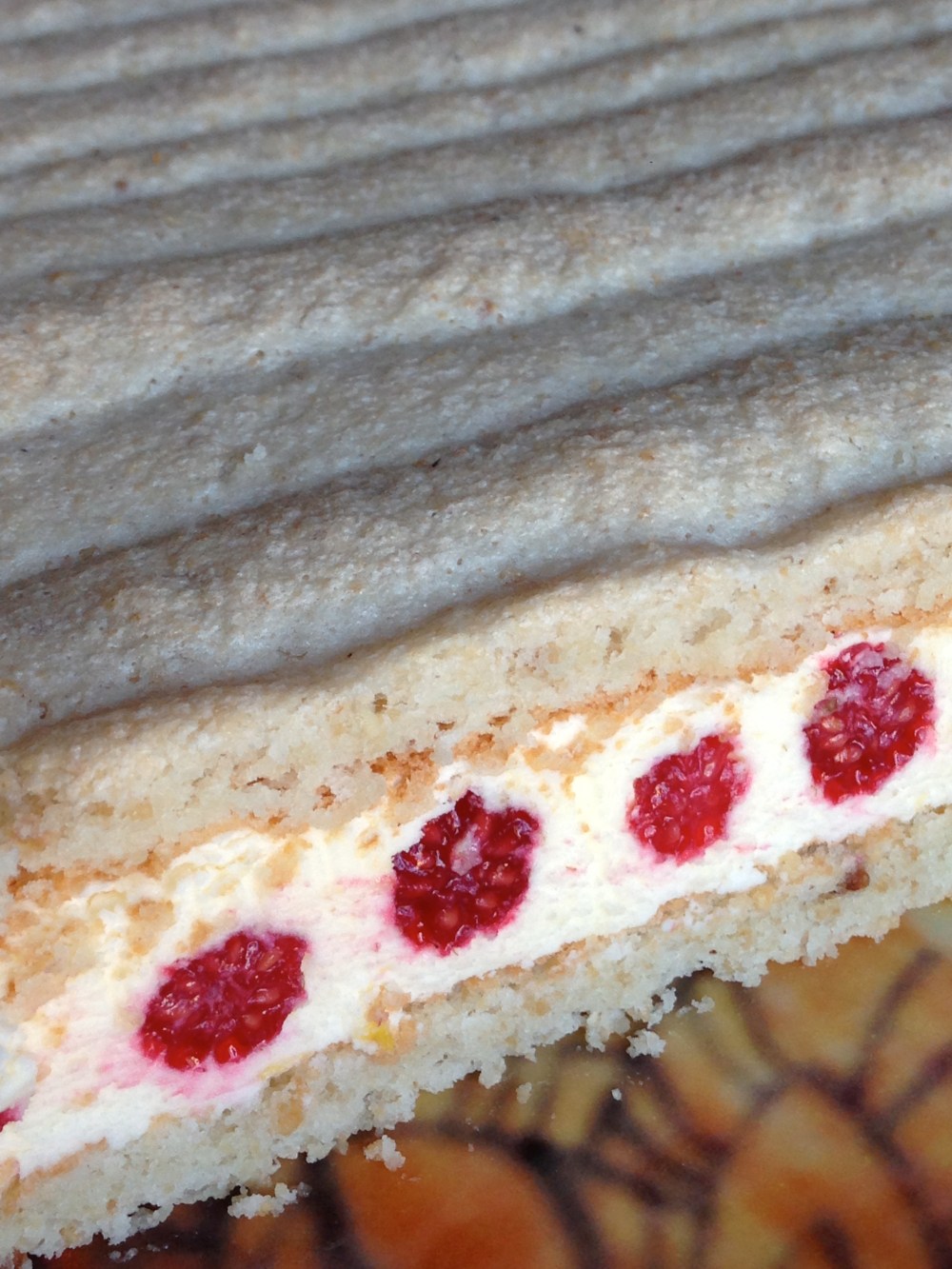
 Like its cousin, the fraisier, this dessert is a deceptively simple celebration of seasonal bounty. Here, ripe raspberries nestle between layers of dacquoise, suspended in a silky buttercream.
The dacquoise requires piping for this recipe, which is easy enough to do and yields the most delicious results.
At first crisp, the dacquoise tends to a pleasant chewiness after having mellowed a day or two in the fridge. Far from being off-putting, this chewiness is charming as another dimension of this dessert.
This recipe is not nearly as labour intensive as its cousin, the fraisier, but it does require some time and effort. Do set aside a morning or afternoon for making and assembling this cake, and don’t plan to eat it until the following day.
This recipe is taken from Christophe Felder’s Patisserie, and has not been adapted. It is perfection.
Preheat your oven to 350 degrees Fahrenheit, and line 2 baking sheets with parchment.
Almond Hazelnut Dacquoise
2 2/3 cups ground almonds
3/4 cup ground toasted hazelnuts*
whites from 10 eggs
1 1/2 cups sugar
Grind the almonds and hazelnuts in a food processor. Blitz them in intervals; you don’t want this to turn into a paste.
Whip the egg whites at medium high speed until foamy, then gradually add the sugar and whip until they become firm and glossy but not dry. Fold in the ground nuts gently, using a flexible spatula.
Spoon the dacquoise batter into a pastry bag fitted with a 1/2 inch tip and pipe bands onto each prepared baking sheet. Count the bands to make sure each is roughly the same size.
Bake the sheets one at a time for 15-20 minutes, rotating the pan halfway through, until the dacquoise is lightly browned. Transfer to racks to cool.
Buttercream
*This buttercream makes use of whole eggs that are separated and then whipped and tempered with sugar syrup. It begins with an Italian meringue and is followed by an egg yolk buttercream, which is then whipped with butter and stirred gently together. It is incredibly labour intensive, but yields a result that is incomparably smooth, light, and with the most silky mouthfeel. It is well worth the extra effort. I should also note that the equipment needed here – a candy thermometer and stand mixer – are absolutely necessary.
Italian Meringue
1/2 cup plus 2 tbsp sugar
3 tbsp water
whites from 3 eggs (between 1/3 and 1/2 cup)
Stir the water and 1/2 cup sugar together in a small heavy saucepan, using a wooden spoon over medium heat, until the sugar has dissolved. Insert a candy thermometer and watch until it registers 244 degrees Fahrenheit – the syrup will be thick and bubbly.
While the syrup is heating, whip the egg whites, at medium high speed, in the bowl of the stand mixer fitted with the whisk, adding the remaining 2 tbsp sugar when the whites become foamy.
Carefully (seriously, this stuff is molten!) pour the sugar syrup down the side of the bowl into the whipped egg whites in a very thin stream and whip at high speed until the mixture cools to room temperature. This will take anywhere between 5 and 10 minutes, depending on the weather and the speed of the mixer. It is important to whip right until it has cooled to room temperature for the meringue to be the proper consistency. When cooled, scrape the meringue into a small bowl and keep it close by.
*For the next steps, there is no need to wash the bowl or the whisk from the stand mixer. Simply use them as they are. You will, however, need to give the saucepan a good rinse in very hot water – any sugar crystals left in the saucepan will encourage crystallization and possibly give you bits of sugar in your buttercream. No need to wash with soap; just melt them off before reusing the saucepan.
Egg Yolk Buttercream
5 egg yolks
1 1/4 cup sugar
1/4 cup plus 2 tbsp water
In a repeat of the meringue method, combine the water and sugar in the saucepan over medium heat, once again watching the candy thermometer until it registers 244 degrees Fahrenheit.
Meanwhile, whip the yolks in the bowl of the stand mixer at medium low speed.
When the syrup is ready, pour it once again down the side of the stand mixer bowl in a thin stream, beating at high speed until the mixture is very thick and pale and forms ribbons as it runs from the whisk into the bowl. It is not necessary to whip this to room temperature, but since it needs to cool before being used, I always whip it to room temperature anyway since whipping hastens the cooling process. When cool, scrape the yolk mixture into another small bowl and keep it close by.
Whip 1 1/2 cup very soft butter in the bowl of the stand mixer until it is creamy and very smooth. Scrape the egg yolk mixture into the butter, whipping at low speed until the mixture is very light. Finally, beat in the Italian meringue on low speed until streak-free and smooth. *I often find a quick blitz or two at high speed is efficacious when combining these mixtures.
The buttercream can be kept at cool room temperature for up to 4 hours, or refrigerated for a day or two. If you’re using refrigerated buttercream, whip it at medium speed until it becomes very light and smooth.
Spoon half the buttercream into a pastry bag fitted with a 1/2 inch tip and pipe it in bands to cover one dacquoise. Arrange 2 cups (give or take, you’ll see how many are needed as you work) of raspberries in rows on the buttercream. Pipe the remaining buttercream over the berries and top with the second dacquoise, pressing it lightly downwards so that it sticks. Chill at least an hour, until the buttercream has set. Use a serrated knife to cut the cake into narrow slices.
 Iced and Spiced