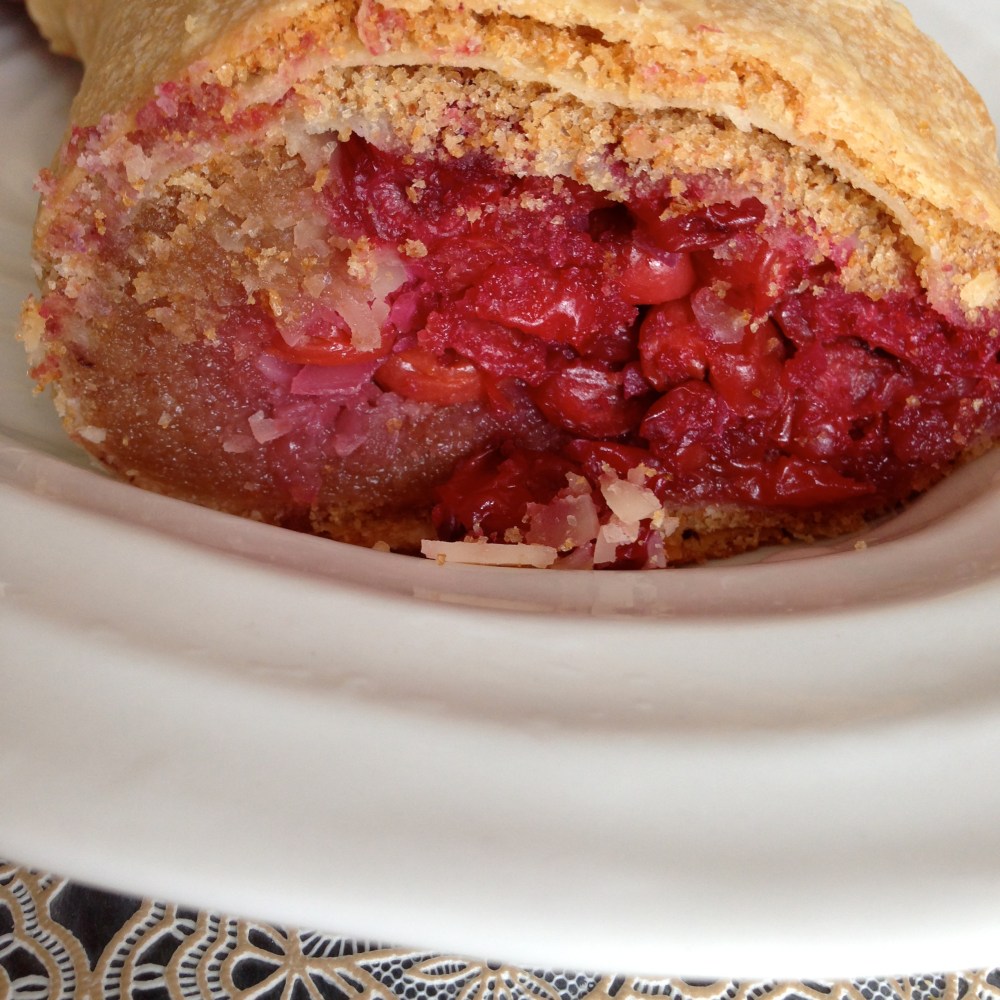
 This recipe is the real deal. It is made with my favourite strudel dough, which itself is quite forgiving and deceptively easy to work with, and let me tell you, this strudel is IMPRESSIVE when finished. The sour-sweet filling and the crunch of the dough form the perfect counterpoint, the slight nuttiness of the almonds enhancing the flavour of the sour cherries. Only use fresh cherries here – frozen ones will become to watery and will cause the strudel to become soggy. The key to strudel is that making it takes time, so do set aside quite a bit to see it through. Read through the recipe until you can picture yourself performing each step in your mind’s eye; now is not the time to realize you’ve forgotten something be it an ingredient or part of the process. And don’t be daunted by the length of this post – I’m including lots of step-by-step photos, anecdotes and tips. Ready?
Sour Cherry Strudel
Strudel Dough
This recipe is adapted from Rick Rodgers’ Kaffeehaus, which is full of recipes for the kinds of pastries one imagines throughout Eastern Europe, and never in one’s own kitchen. This recipe exposes the fallacy of this disappointing daydream, requiring only practice and a good sense of adventure to attempt. I should also note this is one of the few times I eschew traditional, appliance-free methods and eagerly prepare my stand mixer.
1 1/3 cups all-purpose
pinch of salt
scant 1/2 cup of room temperature water
2 generous tbsp neutral cooking oil (I use sunflower seed)
1/2 tsp cider vinegar or white vinegar
Place the flour and salt into the bowl of a stand mixer fitter with the paddle, and in the meantime mix the water, oil and vinegar in a measuring cup. Run the mixer on low speed for a few moments to distribute the salt, then slowly pour the liquid mixture into the dry. Pause in your mixing and poke the dough – it must be soft enough later to roll and pull, and while it will soften further in the fridge you’ll want to add a little more water at this point if it seems hard or tough. A tablespoon or two should do. Now switch to the dough hook, kneading it at medium-low speed until the dough forms a soft ball. It will not be completely smooth, so not to worry if it appears a bit rough.
Scoop the dough out of the mixer bowl and knead it, by hand, for a couple of minutes on an unfloured surface. Slam it down a time or two on the surface. Now gather it up and wrap it well in plastic, or, better yet, pop it in a zipper-top sandwich bag. Place it in the fridge to rest for as long as you can manage, at least 90 minutes and up to two days. (I have found that removing it from the fridge and letting it sit at room temperature for an hour here and there before putting it back into the fridge yields marvellous results.)
When you are ready to stretch the dough, make sure your filling is ready to go; your butter melted; your pan prepared; your oven preheating.
It is best for this part to use a table, kitchen island or other work surface where you can walk around at least three sides, and ideally all four. Cover the surface with a cloth – a tablecloth, or one of my favourites – a muslin receiving blanket. Ideally this cloth will have a pattern of some sort printed on it. Dust the cloth well with flour, and rub the flour right into the cloth. (Word to the wise: when you wash your cloth afterward, for goodness’ sake wash it in cold water, otherwise you’ll have lots of horrid little floury bits stuck to it. Speaking from experience here.)
Now, using a floured rolling pin, roll out the dough as much as you can. It needs to be rolled as thin as possible before you start handling it. When you are ready to stretch with your hands, do remove any rings and bracelets you might be wearing, and make sure your fingernails are short. These are culprits for tearing your dough, and you haven’t made it this far for your strudel dough to snag on your Rolex.
To stretch the dough, simply choose an edge and pick it up, letting gravity and its own weight stretch it back towards your work surface. You are welcome to do this from all sides while you get a feel for the dough. When it gets too large to lift and stretch without contorting yourself, place the dough flat on the work surface. Slide your hands underneath the dough, palms down, and use the backs of your hands to stretch it gently as you move your hands apart. You can also hold one hand on the dough and slide your other hand underneath, stretching from where you have it anchored in an outward motion. Although it seems counterintuitive, and indeed is the opposite of what many suggest, I have found it most effective to stretch the outside first – stretch the edges as much as possible from underneath moving outward, then move your hands a little further toward the centre of the dough, again stretching it outward. Repeat this process as many times as necessary, always stretching out from closer and closer to the middle toward the edges. My method is thus: by stretching the edges first, you ensure that the thick edge will be as narrow as possible when it is time to cut it off, thereby wasting less dough. If you were to start stretching from the middle out, the middle would be lovely and thin, but the rest of the dough would be thicker, requiring extremely careful handling so as not to tear the thin dough in the middle while attempting to stretch the dough all around the thinnest part.
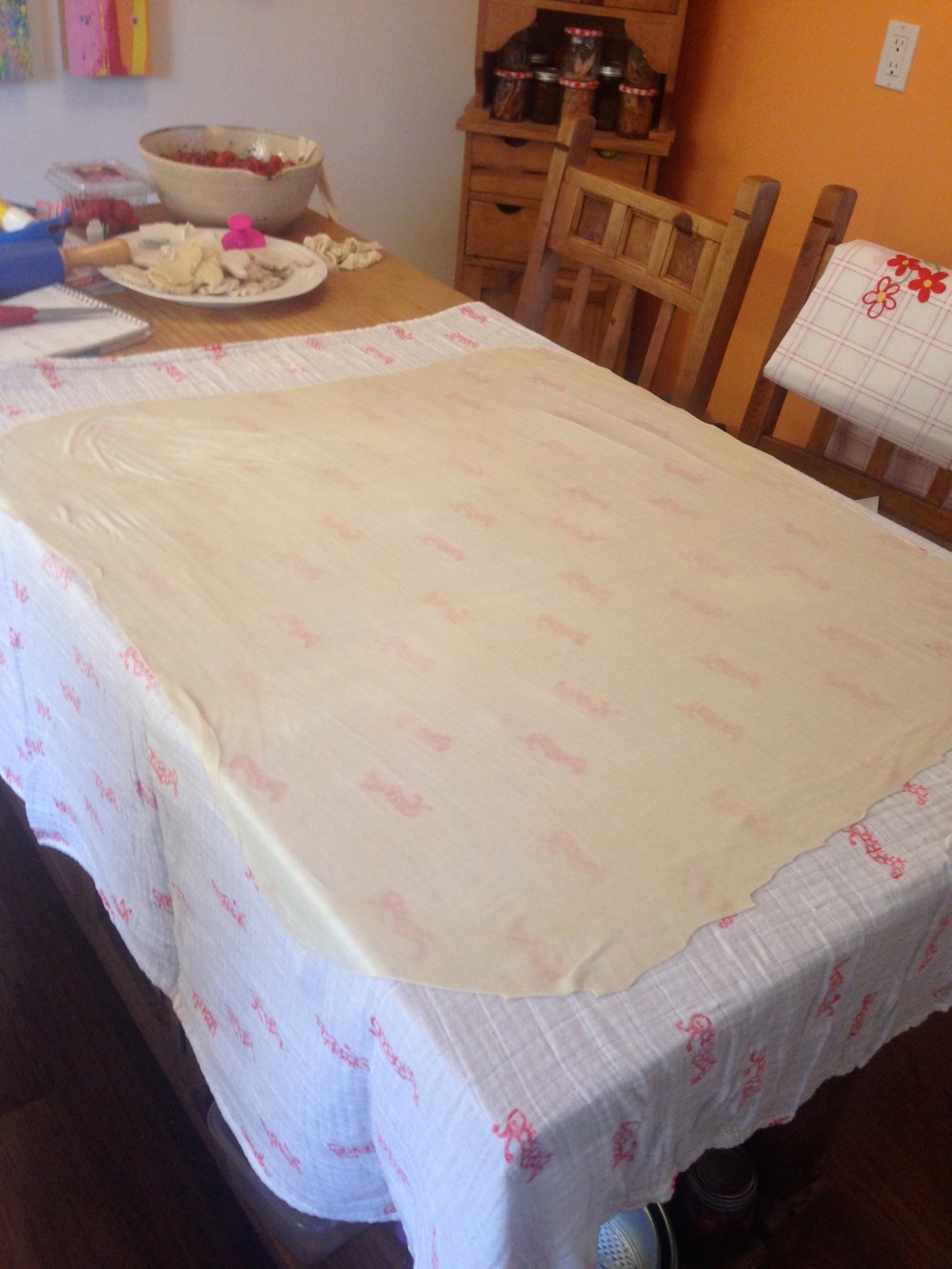
When the dough has been stretched tissue-thin and the pattern of the cloth beneath is clearly visible, use scissors to trim away the thick band of dough around the edges and discard it. A few small holes are okay since the strudel will be rolled up anyway.

Sour Cherry Filling
1/2 cup melted unsalted butter
1 cup fresh breadcrumbs, toasted in unsalted butter
1/2 cup finely chopped sliced almonds
3/4 cup sugar
2 pounds (about 4 cups) fresh sour cherries, pits removed
Preheat your oven to 400 degrees Fahrenheit. Place an oven rack in the upper third of the oven. Line a baking sheet with parchment.
Once your strudel dough is ready to be filled, brush half the melted butter over the dough. Be very careful not to tear the dough here! Spoon the breadcrumbs in a wide strip (about 6 inches) 2 inches in from the sides and bottom of the dough, with a short edge facing you. You can sprinkle a light dusting of breadcrumbs over the rest of the dough to soak up any juices. Sprinkle the almonds on top of the crumbs. Toss the cherries with the sugar, stirring gently, and pour the lot over the almonds and breadcrumbs, really scraping the bowl. The sugared cherry juice in the bottom is like gold dust and will be soaked up by the breadcrumbs and almonds.


First, fold the bottom edge up over the filling, followed by the sides. Now, pick up the edge of the cloth to help you roll the strudel over onto itself in one motion, rolling it over and over until it is all rolled up. Using your hands, lift the strudel (which is sturdier than you think, so have courage) onto your prepared baking sheet, curving it into a horseshoe (or rainbow or whatever u-shape makes you feel particularly proud in the moment) so it fits on the baking sheet. Tuck the ends under. Brush the top, sides and ends of the strudel with the remaining melted butter until it is well-lacquered and shiny.
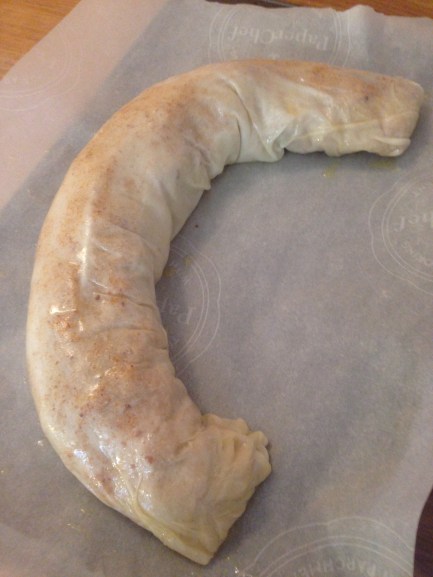
Bake until the strudel is a deep golden brown, about 30 minutes, and cool for at least 30 minutes and longer if you can bear it. Use a serrated knife to cut the strudel and serve it warm or at room temperature.


 Iced and Spiced